Bayesian parameter reconstruction using Bayesian optimization
- Driver:
Download script: bayesian_reconstruction.m
The target of the study is to showcase the solution of a Bayesian parameter reconstruction problembased on a set ot measurements \(\mathbf{t} \in \mathbb{R}^K\).
We assume that the measurement process can be accurately modeled by a function \(\mathbf{f}(\mathbf{b}) \in \mathbb{R}^K\). As an example we consider the MGH17 problem which consists of fitting a vectorial model \(\mathbf{f}(\mathbf{b}) \in \mathbb{R}^{33}\) with
to a measurement vector with \(K = 33\) entries.
Due to random measurement noise \(\mathbf{w} \sim \mathcal{N}(0, {\rm diag}{[\eta_1^2,...,\eta_K^2]})\), the vector of measurements \(\mathbf{t} = \mathbf{f}(\mathbf{b}) + \mathbf{w}\) is a random vector with probability density
The noise variances \(\eta_i^2\) shall be unknown and estimated from the measurement data. To this end we assume that the variance is composed of a background term \(c_1^2\) and a noise contribution which scales linearly with \(f_i(\mathbf{b})\), i.e.
Taking non-uniform prior distributions for the design parameter vector \(P_\text{prior}(\mathbf{b})\) and the error model parameters \(P_\text{prior}(\mathbf{c})\) into account the posterior distribution is then proportional to \(P(\mathbf{b}, \mathbf{c} | \mathbf{t}) \propto P(\mathbf{t} | \mathbf{b}, \mathbf{c}) P_\text{prior}(\mathbf{b}) P_\text{prior}(\mathbf{c})\).
Alltogether, the target of finding the parameters with maximum posterior probability density is equivalent of minimizing the value of the negative log-probability
In the following, we show how this negative log-probability can be minimized using the BayesianReconstruction driver. We compare the results of the dirver’s MCMC sampling of the posterior probability to an MCMC sampling of the analytic value.
  1server = jcmoptimizer.Server();
  2client = jcmoptimizer.Client('host', server.host);
  3
  4% Definition of the search domain
  5design_space = { ...
  6  struct('name', 'b1', 'type', 'continuous', 'domain', [0,10]), ...
  7  struct('name', 'b2', 'type', 'continuous', 'domain', [0.1,4]), ...
  8  struct('name', 'b3', 'type', 'continuous', 'domain', [-4,-0.1]), ...
  9  struct('name', 'b4', 'type', 'continuous', 'domain', [0.05,1]), ...
 10  struct('name', 'b5', 'type', 'continuous', 'domain', [0.05,1]) ...
 11};
 12
 13 % Creation of the study object with study_id 'bayesian_reconstruction'
 14study = client.create_study( ...
 15    'design_space', design_space, ...
 16    'driver','BayesianReconstruction',...
 17    'study_name','Bayesian parameter reconstruction using Bayesian optimization',...
 18    'study_id', 'bayesian_reconstruction');
 19%The vectorial model function of the MGH17 problem
 20function val = model(x)
 21    s = 0:32;
 22    val = x(1) + x(2)*exp(-s.*x(4)) + x(3)*exp(-s.*x(5));
 23end
 24
 25%The forward model parameters b to be reconstructed
 26b_true = [3.7541005211E-01, 1.9358469127E+00, -1.4646871366E+00, ...
 27 1.2867534640E-01,2.2122699662E-01];
 28
 29%The error model parameters in log-space to be reconstructed
 30log_c1 = log(0.005);
 31log_c2 = log(0.01);
 32
 33%The error model, i.e. the noise stddev depending on the model value y=f(b)
 34function stddev = error_model(log_c1, log_c2, y)
 35    stddev = sqrt( exp(log_c1)^2 + (exp(log_c2).*y).^2);
 36end
 37
 38%Generate a rantom target vector of measurements
 39rng("default");
 40model_vector = model(b_true);
 41err = error_model(log_c1,log_c2,model_vector);
 42measurement_vector = model_vector + err.*randn(size(model_vector));
 43
 44%Configuration of the error model
 45err_model_conf = struct();
 46%error model expression
 47err_model_conf.expression = 'sqrt(exp(log_c1)^2 + (exp(log_c2)*y_model)^2)';
 48%distribution of error model parameters
 49err_model_conf.distributions = { ...
 50   struct('type', 'normal', 'parameter', 'log_c1', 'mean', -5.0, 'stddev', 1), ...
 51   struct('type', 'normal', 'parameter', 'log_c2', 'mean', -4.0, 'stddev', 1), ...
 52};
 53%initial values and parameter bounds for fitting the error model parameters
 54err_model_conf.initial_parameters = [-5.0, -4.0];
 55err_model_conf.parameter_bounds = [-7,-2; -6.0,-1];
 56
 57%Multivariate normal prior distribution of forward model parameters.
 58%Unspecified parameters (b1,b4,b5) are uniformly distributed in the design space
 59distribution = struct();
 60distribution.type='mvn';
 61distribution.parameters = {'b2','b3'};
 62distribution.mean = [2.25,-2.0];
 63distribution.covariance = [0.5,-0.01;-0.01,0.5];
 64parameter_distribution = struct();
 65parameter_distribution.distributions = {distribution};
 66
 67study.configure( ...
 68    'max_iter', 80, ...
 69    'target_vector', measurement_vector, ...
 70    'error_model', err_model_conf, ...
 71    'parameter_distribution', parameter_distribution ...
 72);
 73% Evaluation of the black-box function for specified design parameters
 74function observation = evaluate(study, sample)
 75
 76    observation = study.new_observation();
 77    %array of design values
 78    x = [sample.b1, sample.b2, sample.b3, sample.b4, sample.b5];
 79    observation.add(model(x));
 80
 81end
 82
 83% Run the minimization
 84study.set_evaluator(@evaluate);
 85study.run();
 86
 87best_b_sample = study.driver.best_sample;
 88min_neg_log_prob = study.driver.min_objective;
 89
 90%determine sample [b1, b2, b3, b4, b5, log_c1, log_c2] that minimizes the negative
 91%log-probability
 92minimum = struct2array(best_b_sample);
 93
 94%path to negative log-probability variable
 95path = 'driver.acquisition_function.main_objective.variable';
 96neg_log_probs = study.historic_parameter_values([path, '.observed_value']);
 97[min_val, idx] = min(neg_log_probs);
 98
 99logs_c1 = study.historic_parameter_values([path, '.error_model_parameters.log_c1']);
100logs_c2 = study.historic_parameter_values([path, '.error_model_parameters.log_c2']);
101
102minimum = [minimum, logs_c1(idx), logs_c2(idx)];
103
104% Before running a Markov-chain Monte-Carlo (MCMC) sampling we converge the surrogate
105% models by sampling around the minimum. To make the study more explorative, the
106% scaling parameter is increased and the effective degrees of freedom is set to one.
107study.configure( ...
108    'scaling', 10.0, ...
109    'effective_DOF', 1.0,  ...
110    'min_uncertainty', abs(min_neg_log_prob)*1e-8, ...
111    'max_iter', 120 ...
112);
113while(not(study.is_done))
114   sug = study.get_suggestion();
115   obs = evaluate(study, sug.sample);
116   study.add_observation(obs, sug.id);
117end
118
119% Run the MCMC sampling with 32 walkers
120num_walkers = 32; max_iter = 10000;
121mcmc_result = study.driver.run_mcmc( ...
122    'rel_error', 0.01, ...
123    'num_walkers', num_walkers, ...
124    'max_iter', max_iter ...
125);
126% This Matlab code does not contain a detailed analysis of the MCMC sampling by corner plots.
127% Please, see the corresponding Python tutorial for a code example.
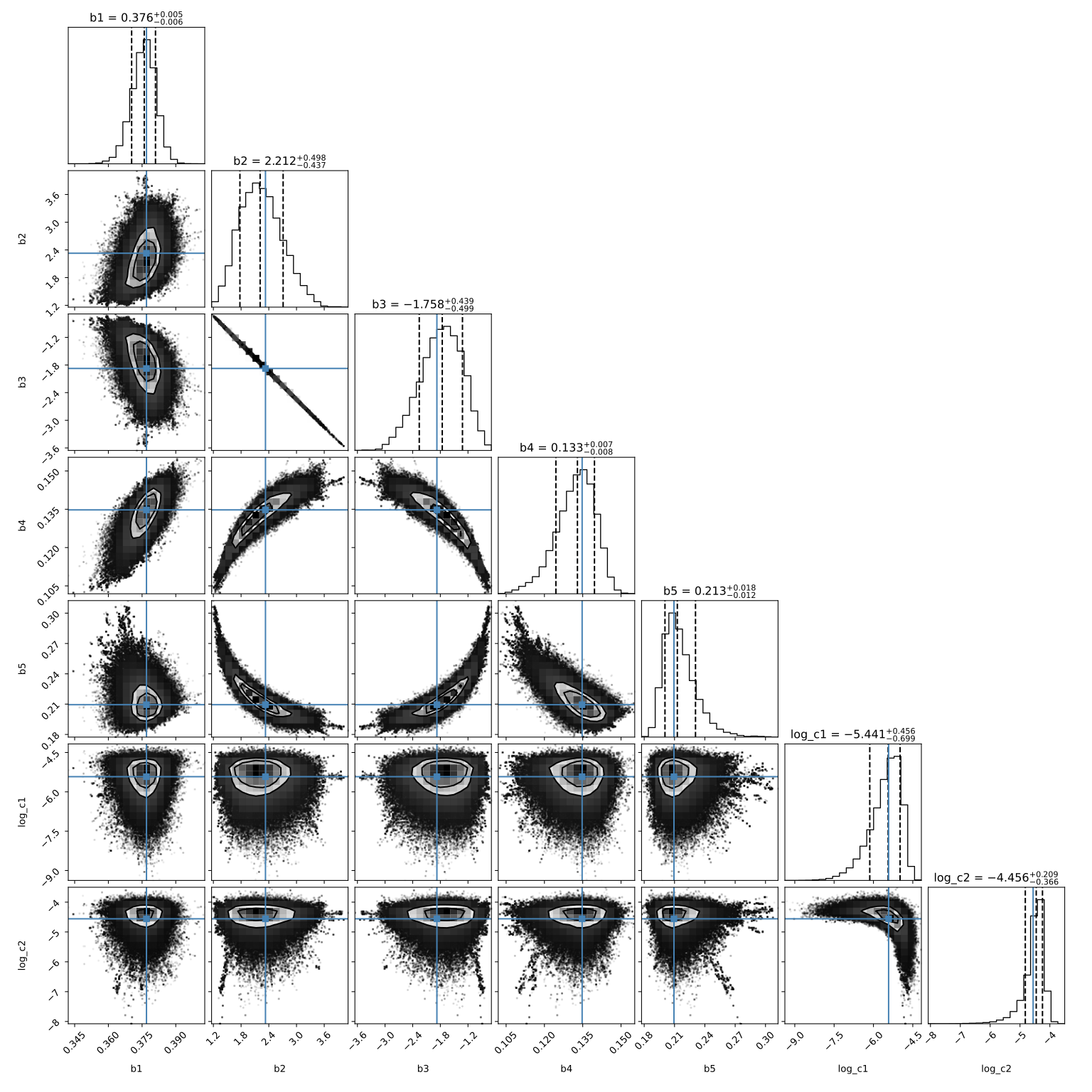
Markov-Chain Monte-Carlo (MCMC) sampling of the probability density of the model parameters \(b_1,\dots,b_5\) and the log value of the error model parameters \(c_1,\dots,c_2\) based on the analytic model function.
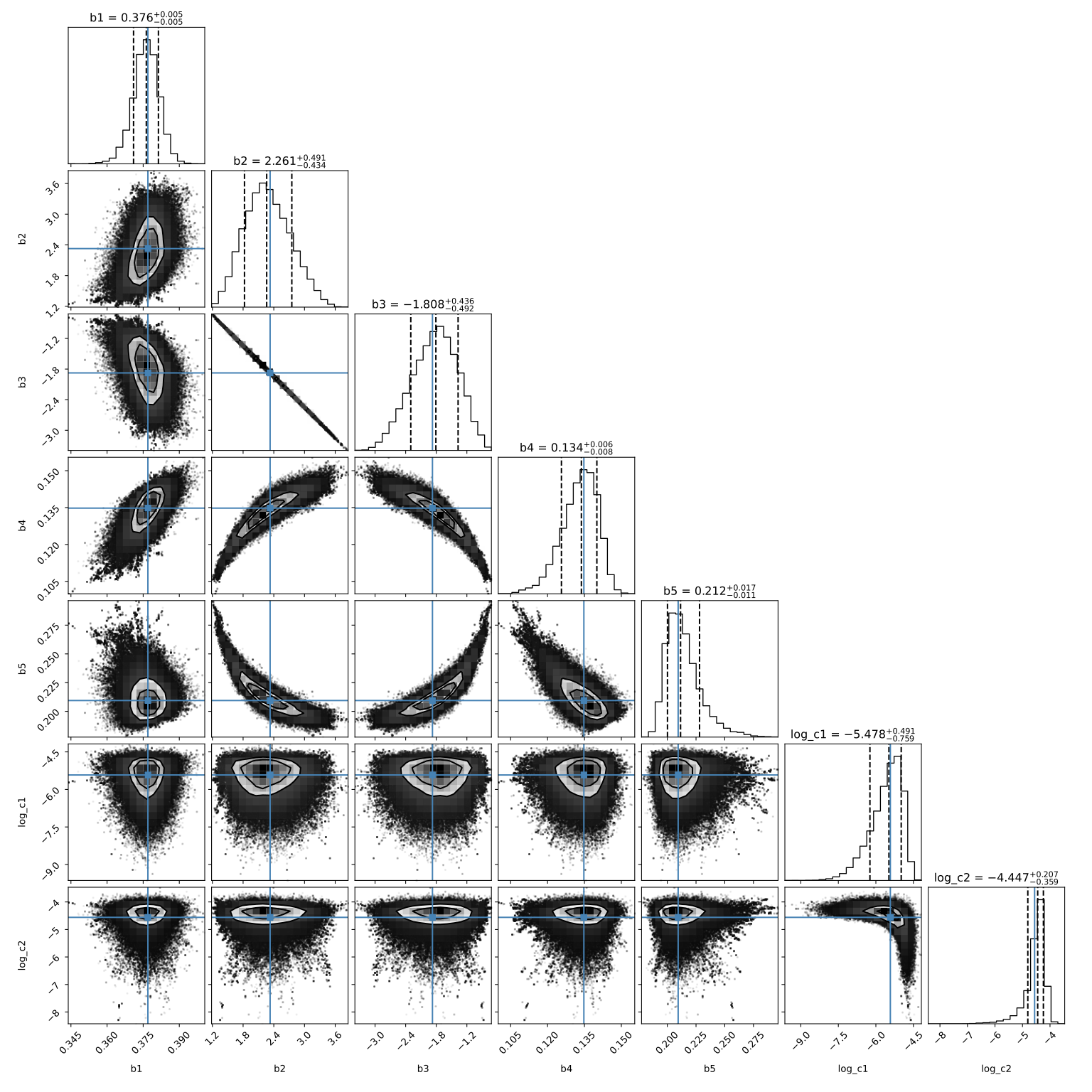
Markov-Chain Monte-Carlo (MCMC) sampling of the probability density of the model parameters \(b_1,\dots,b_5\) and the log value of the error model parameters \(c_1,\dots,c_2\) based on the trained surrogate of the study. A comparison between the analytic and the surrogate model function shows a good quantitative agreement.